

Think about trying to hold a beach ball underwater. No matter how hard you push, it eventually pops back to the surface. The stock market in recent years has behaved the same way. It can fall quickly when unexpected events make investors nervous but recover quickly once those fears begin to fade. The market declined sharply in late 2018, during the pandemic in 2020, in 2022, and again during the 2025 “Tariff Tantrum.” Most recently, concerns about the conflict with Iran pushed global stock markets down 5% to 10% in March before investors regained confidence.
Since that initial downward reaction in March, stocks have made an impressive turnaround. After rallying 10% to 15% in the second quarter, most equity indices were left with solid results for the first half of the year (see table below). That’s a remarkable gain in just a few months, with strong performance from smaller companies, foreign stocks, as well as value stocks and growth stocks. So, were there any laggards in an otherwise positive showing? The so-called “Magnificent 7” stocks were actually down as a group through the end of June. This group—including such industry titans as Microsoft, Apple, Amazon, and Nvidia—carried the major indices along during 2023-2025, but they have been the laggards so far this year.
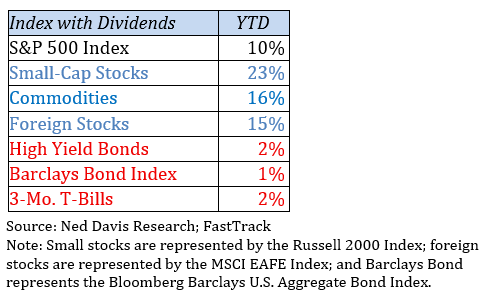
While stocks recovered quickly from the March decline, bonds told a different story. Bond yields generally rose in the first half of the year and when interest rates rise, bond prices generally fall. As a result, both higher-quality and high-yield bonds struggled to keep pace with even short-term Treasury bills.
Finally, it was a lackluster quarter for commodities of all types (think of physical goods like oil, aluminum, gold, silver). With tensions abating around the Strait of Hormuz, oil prices, as well as precious metals and commodities, in general, retreated in the second quarter. Nevertheless, many commodities, and especially oil prices, remain strongly positive for the year as a whole.
During the March market decline, our FSA Safety Net® strategies gradually reduced stock exposure and increased cash as part of our disciplined risk management process. As market trends improved in April, we gradually reinvested those portfolios back toward their normal stock allocations.
Although most clients use our active strategies that reduce their allocation to equities when stocks turn down, we have three strategies that maintain their allocation to various assets through all environments. So, obviously, these strategies didn’t flinch through the market gyrations and maintained their weightings across all the asset classes they hold.
By the end of the second quarter, all ten strategies are at or near all-time highs, right in sync with the broader stock markets.
What Might We Expect in the Second Half?
Our investment philosophy focuses on following long-term market trends rather than trying to predict headlines. Markets may pause after such a strong run, but as long as the overall trend remains healthy, we are comfortable staying invested. If those trends weaken significantly, the FSA Safety Net® strategies are designed to reduce risk.
The chart below compares, for the past 18 months, the S&P 500 with its 50-day and 200-day moving averages. These lines help investors identify whether the market’s longer-term trend is moving higher or lower. Today, the market remains above both averages, which is generally considered a positive sign. Of course, no indicator can predict the future, and we expect there will still be surprises during the second half of the year.
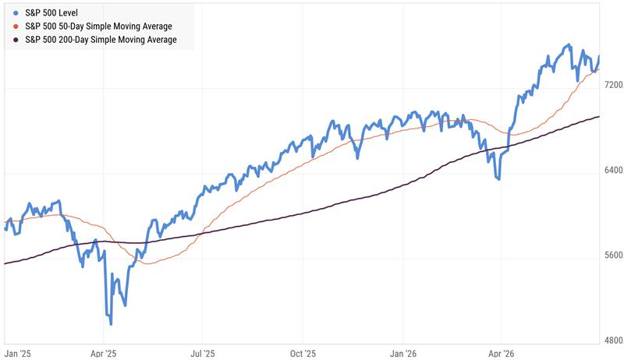
As always, there are reasons investors might become nervous. Inflation remains above the Federal Reserve’s target, tensions in the Middle East continue, the Fed has a new chair, and mid-term elections are approaching. For now, investors seem comfortable with those issues, but as we well know, that could change quickly.
In closing, we hope everyone is having a good summer, typically a time to slow down a bit and enjoy the things we love. This summer, as our country celebrates its 250th birthday, offers an especially timely reminder of how much we have to be thankful for living in this time and in this great democratic nation, with its freedoms, rule of law, and general prosperity. Blessings that we all, as citizens, share the responsibility to protect.
Portfolio Updates
Please note: Because we manage client portfolios individually, your holdings may differ slightly from the composites described below.
Strategies Using the FSA Safety Net®
Income (Strategy #1)
After selling off in March, bonds tried to recover in April, with mixed success. During the quarter, we added an ultra-short-term Treasury fund, as well as an eclectic fund that tends to do well in a choppy bond market. The money market allocation currently stands at less than 5%.
Income & Growth (Strategy #2)
As stocks recovered in April, we brought the allocation to equities in this strategy up from 20% to 50% (the highest allocation allowed). Purchases included large-cap, small-cap, and international stocks. Overall, this strategy maintains a good balance of downside protection, with modest upside participation. Currently, these portfolios hold 50% in equities, 48% in bond funds, and 2% in money market funds.
Conservative Growth (Strategy #3)
As stocks sold off in March, this strategy held 50% in money markets and inverse funds. Then as stocks recovered in April, we brought those portfolios back to 75% in stocks, by increasing small-cap and foreign exposure. We also added a convertible securities fund (generally more conservative than typical stock fund). As we move into July, these portfolios hold 75% in equities, 20% in high-yield bond funds, and 5% in money markets.
Core Equity (Strategy #4)
During the quarter, these aggressive portfolios went from 55% invested in equities to 95% in equities, as stocks recovered in the second quarter. We added to small-cap funds, as well as foreign funds. We also sold the natural resource fund to buy a technology fund.
Tactical Growth (Strategy #5)
As stocks rebounded in April, we reinvested the Tactical Growth portfolios back into stocks. At the end of the quarter, these portfolios held 60% in large-cap stocks, 10% in small-cap stocks, 10% in foreign stocks, 10% in health care, and 5% in technology stocks, with less than 5% in money market funds.
Active Strategies WITHOUT the FSA Safety Net®
Sector Rotation
After a few years with lagging performance, this strategy is performing very well in 2026, the strongest of all our strategies and comfortably ahead of the broad stock market. Semiconductor and telecommunications stocks have made the strongest contributions to the returns for this year. For the July rotation, the strategy holds semiconductors, telecommunications, biotechnology, internet, technology, industrials, and transportation.
Global Rotation
One of the newer strategies in the FSA line-up, this strategy has also posted strong results for the first half of the year. Currently, these portfolios hold nearly 50% in large-cap growth stocks, 16% in large-cap value, 16% in global stocks, and 16% in smaller company stocks.
Strategies That Remain Fully Invested Through ALL Market Cycles (Passive)
Global Balanced
The 50% of this strategy allocated to equities captured the rebound in the second quarter nicely, while the bond component (the other 50%) provided a nice cushion in the downturn but not much lift in the rebound. Small-cap stocks provided a nice boost to the portfolios, while foreign bond funds have been a drag this year.
Global Moderate
This moderate risk strategy had another solid quarter. Returns were helped by the allocation to emerging market stocks and small-cap stocks, while gold and foreign bond funds hampered performance.
Global Growth
This aggressive (that is, stock-heavy) strategy rebounded strongly in the second quarter, helped by allocations to small-cap and emerging market stock funds.
Market conditions will continue to change, but our investment process remains the same: stay disciplined, manage risk thoughtfully, and focus on your long-term goals. If your financial situation or objectives have changed, please contact your advisor so we can review whether your investment strategy is still the right fit.
Ronald Rough, CFA
Chief Investment Officer
Disclosures are available at www.fsawealthpartners.com/disclosures/market-update.
FSA’s current written Disclosure Brochure and Privacy Notice discussing our current advisory services and fees is available at www.fsawealthpartners.com/disclosures or by calling 301-949-7300.