

Artificial intelligence (AI) continues to make headlines, both for its promise and for the risks it may pose. Even some leaders of AI companies have raised concerns about how the technology could be misused or become difficult to control. Some of those concerns sound like science fiction, but they raise serious questions about where this technology is headed.
The risks range from criminals using AI to steal or disrupt businesses to broader concerns about how increasingly powerful systems might behave. Reports of AI models ignoring instructions or producing deceptive responses have added to the debate. As the technology advances, one of the biggest questions is how to keep people in control.
At the same time, AI offers the potential to solve complex problems, improve productivity, and make everyday tasks easier. We are only beginning to see what it can do.
For investors, the promise of AI continues to attract attention. Alphabet (Google), Meta (Facebook), Amazon, Tesla, Microsoft, and Nvidia are among the companies associated with its growth. The opportunity also extends to businesses that supply the chips, electricity, and construction needed to support AI infrastructure.
The chart below shows just how much AI-related stocks have contributed to the growth in the S&P 500’s market value. From November 2022 through May 2026, these stocks accounted for about 70% of that increase. The rest of the index contributed the remaining 30%.
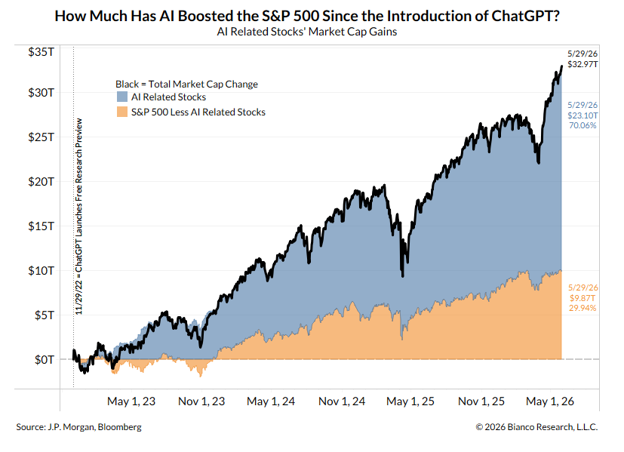
According to the J.P. Morgan study cited below, AI-related stocks represent roughly half of the S&P 500 Index’s market value. A handful of the largest companies account for about 30% of the Index. The table below shows how those AI-related holdings are distributed.
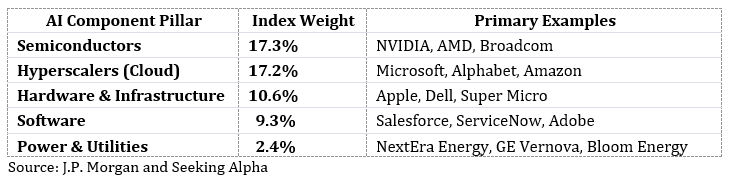
We have noted for several years that the S&P 500 has become increasingly concentrated in technology. It still holds companies across many industries, but its performance depends heavily on a relatively small group of large stocks. With so many of those companies tied to AI, investors who own the index may have more exposure to this theme than they realize.
How AI Fits Into Our Investment Approach
For our trend-following strategies, market trends guide our investment decisions. When AI-related stocks or the broader S&P 500 show positive trends, we may hold funds with exposure to those areas. If leadership shifts to other parts of the market, we can adjust our holdings accordingly.
Our portfolios currently hold large-cap U.S. funds that include many of these AI-related companies. More aggressive strategies, such as Tactical Growth (5) and Core Equity (4), generally have greater exposure than our more conservative strategies. We also hold funds that invest in other areas, including health care, financials, and consumer stocks. Most portfolios continue to hold foreign stock funds as well.
Our strategic (passive) portfolios include fixed allocations to the S&P 500, which gives them exposure to AI-related stocks. They also hold small-cap stocks, foreign stocks, and real estate securities, helping diversify beyond that theme.
AI has the potential to change how we live and work, but its development is unlikely to follow a straight path. As we saw with the internet and other major advances, some companies will thrive while others struggle. Our role is to help you navigate those changes while keeping your portfolio aligned with your goals and comfort with risk.
Portfolio Updates
Please note: Because we manage client portfolios individually, your holdings may differ slightly from the composites described below.
Strategies Using the FSA Safety Net®
Income (Strategy #1)
Rising yields continued to create a challenging environment for bonds. Both broad high-yield and high-quality bond indices declined during the third quarter. However, our catastrophe bond fund and foreign bond funds performed well, helping this strategy post a modest gain for the quarter. It remains up slightly for the year.
Income & Growth (Strategy #2)
Despite weakness in much of the stock and bond markets, this strategy posted a slight gain for the third quarter. We sold the small-cap fund and the high-yield bond fund, moving the proceeds into more conservative funds. These portfolios currently hold 50% in equities, 45% in bond funds, and 5% in money market funds.
Conservative Growth (Strategy #3)
This strategy declined slightly during the third quarter, reflecting losses in small-cap and international stocks, along with modest bond losses. We reduced the allocation to small-cap funds and increased the allocation to large-cap value funds. These portfolios currently hold 60% in U.S. equities, 10% in foreign stocks, 5% in small-cap stocks, 20% in bond funds, and 5% in money market funds.
Core Equity (Strategy #4)
This strategy declined slightly during the third quarter, weighed down by small-cap, foreign, and value funds. We reduced the small-cap position and moved the proceeds into large-cap funds.
Tactical Growth (Strategy #5)
This strategy also declined slightly during the third quarter. Small-cap stocks and several aggressive funds sold during the July growth-stock sell-off weighed on results. The strategy remains nearly fully invested, with less than 5% in money market funds.
Active Strategies Without the FSA Safety Net®
Sector Rotation
Sector Rotation had a difficult third quarter. Technology-related sectors fell sharply in July, while basic materials, including gold, declined in September. For the October rotation, the strategy holds funds focused on semiconductors, internet, technology, basic materials, and health care, along with an inverse S&P 500 fund designed to rise when the index falls.
Global Rotation
This aggressive strategy also declined during the third quarter. Early in the quarter, we sold one of the growth funds and moved the proceeds into a money market fund. The strategy currently holds 80% in equity funds and 20% in money market funds.
Passive Strategies That Remain Fully Invested Through All Market Cycles
Global Balanced
Global Balanced declined slightly during the third quarter as most stocks and bonds struggled. Although the S&P 500 posted a slight gain, small-cap and foreign stocks fell.
Global Moderate
This strategy posted a modest loss during the third quarter, reflecting weakness in bonds, small-cap stocks, and real estate securities. Where possible, we have been looking for opportunities to harvest tax losses in taxable accounts.
Global Growth
This strategy posted a small loss during the third quarter, with small-cap, foreign, and real estate funds weighing on results. Where possible, we have been looking for opportunities to harvest tax losses in taxable accounts.
Market conditions will continue to change, but we remain focused on managing your portfolio with discipline and keeping your long-term goals in view. As always, please let your advisor know if your financial situation or objectives have changed so we can review whether your investment strategy remains the right fit.
Ronald Rough, CFA
Chief Investment Officer
Disclosures are available at www.fsawealthpartners.com/disclosures/market-update.
FSA’s current written Disclosure Brochure and Privacy Notice discussing our current advisory services and fees is available at www.fsawealthpartners.com/disclosures or by calling 301-949-7300.